Sunday, 22 February 2015

Japanese in Karate 26 “kumite”

“Kumite” is sparring. It originally means grappling hands. kumi = tie up, te = hand
☆ Yakusoku kumite         
“yakusoku” = promise, appointment
It is one step, 3 step or 5 step sparring with fixed (set) movement.
(1step) ippon-kumite, (3steps) sanbon kumite, (5steps)  gohon-kumite
The defender steps back each time, blocking the attacks and performing a counter attack after the last block.
☆ Jiyu kumite
“jiyu” = free             It is a free sparring.
☆ Shiai
“shiai” is a competition.
Here are some Japanese words which are used in kumite and shiai.
☆ Shushin ni rei                    bow to the referee (shushin = chief referee, ni = to, rei = bow)
☆ Otagai ni rei                      bow to each other
☆ Kamaete                            be ready
☆ Hajime                               Start!
☆ Yame                                 Stop!
☆ Zokko/ Tsuzukete             Continue!
☆ Waza ari                             a point with good technique (but not enough to overpower the opponent)        waza = technique,  ari = there was
☆ Ippon                                  a winning point (it literally means ‘one’)
It is awarded for a technique with good form and with little opportunity for the opponent to defend against it
☆ Awasete ippon                    "awasete" means to combine together
                                 Usually two “waza ari” becomes “ippon” (waza ari is considered as half point)                                      So when a fighter gets the second “waza-ari”, the judge will say "awasete ippon”               
☆ Hikiwake                             draw
☆ Encho/encho-sen                extension/extension fight
☆ Taiju hantei                          taiju = body weight, hantei = decision  
☆ aka - shiro                         red - white
☆ kachi - make                        won - lost                                        
You can hear some words in this video too : https://www.youtube.com/watch?v=sUWPvWkehlM


Thursday, 18 December 2014

Japanese in Karate 25 “kata” "ibuki"

“Kata” means ‘form’


The definition of “kata” in Karate :
Assuming the fight is against various enemies, you perform the predetermined techniques in predetermined order.

 “Kata” is different in different styles of karate and there are different opinions towards “kata”.
Therefore, I just translate what I learned and what I read on the internet.

These are the points of kata:
1.“Kata” is the completion of “kihon”.
2.“Chikara no kyoujaku” :  chikara = power,  kyoujaku = strong and week
     It means that it’s important to differentiate the strength of power according to the technique.       
3.“Waza no kankyu”       :   waza = technique, kankyu = fast and slow
     It means that it’s important to differentiate the speed of techniques    

Now I don’t translate the names of “Kata” since they are not simple Japanese words and I don’t understand most of their meanings. Even Japanese people remember those names of kata just from the sound of it.

Another important thing in kata is ‘breathing’
“Kokyu hou” = breathing technique    “kokyu” is breathing and “hou” is the way

One of the “kokyu hou” in kata is “ibuki”.
 “ibuki” also means ‘breathing’

And the meanings of this breathing in karate are:
To tighten the whole body
To raise the concentration
To strengthen the internal organs

I am not a karate teacher and I cannot explain how to do “ibuki” properly but I’d like to introduce an explanation that I found on the website of a Japanese Shihan. Because his instruction really helped me understand how to do “ibuki” better.

"When you breathe in (the air goes in to the lung), instead of blowing up the stomach, you make a dent in the stomach. And when you breathe out from the mouth, you plump out the stomach and concentrate the power into lower stomach."

This is also called “tanden kokyu”.   In the picture, the red point inside the stomach is "tanden". (the red point on the surface is a belly button)

I attach here 2 videos. One is an amazing kata practice (Kankudai) by 7 year old Japanese girl and the other one is a demonstration of Tensho kata(with ibuki). The sensei who performs in the video was my own sensei in Tokyo.


Friday, 19 September 2014

Japanese in Karate 24 “other stances”

★  Neko-ashi dachi

“Niko” means ‘a cat’ and “dachi” is ‘a stance’.
Neko-ashi dachi is like “kokutsu dachi”(explained in blog no.22) but you put 90% of your weight on the back leg(knee is bent) and 10% on the front leg. The front “chusoku” is just touching the floor so that you can kick anytime, just like a cat can jumps up lightly and quickly.

★  Tsuru-ashi dachi  /  Sagi-ashi dachi

“Tsuru” is ‘a crane’, “sagi” is ‘a heron’, both are the name of birds which have long legs, and they both often stand on one leg. So these are the stances just like those birds, standing on one leg and the other leg is bent so that you can kick freely. In Tsuru-ashi dachi , the foot is placed on the side of the other leg. In Sagi-dachi, the foot is placed bent behind the other leg.


★  Kosa  or Kousa
“Kousa” means ‘cross’. Crisscross
★  Hanmi
“Han” means ‘half’ and “mi” means ‘body’. You don’t stand with both shoulders facing forward but rather turn slightly (half body) so only the front shoulder faces forward. It makes the opponent difficult to attack you.
★  Han kiba-dachi
“Han” means ‘half’ so this is a half “kiba-dachi”. You open the legs half wide from kiba-dachi.

 ★  Suri ashi
“Suri” means ‘to scrub’ and “ashi” is ‘foot’. It is a movement when you move the leg without lifting up from the floor, like scrubbing the floor with feet.

Sunday, 25 May 2014

Japanese in Karate 23 “other punches”

★  Jun zuki
“Jun” means ‘follow, not oppose’ and “zuki” is “tsuki”= punch.
When you are standing with either side leg front, if you punch with the same side hand as the front leg it’s called “jun-zuki”. If you punch with the opposite side hand from the front leg, it’s called “gyaku-zuki”.  “Jun-zuki” and “oi-zuki”(I explained in No.22) sound the same punch, but “oi-zuki” means ‘a chasing punch’ so only when the back leg step forward and punch with the same side hand, it’s called “oi-zuki”.
In the training, we normally use it when stepping into kiba dachi. We punch jun-zuki in the direction we face (with the same side hand as the leg) and then do successive jun-zuki each time facing a different direction or in “idou geiko”,each time towards the proceeding leg.      
★  San-bon zuki / Go-hon geri
In Japanese, when we count something, we add a certain word after the number.
When we count punches or kicks, we add “hon”.
1   ippon (it should be “ichi-hon” but we say “ippon” for the convenience of pronunciation)
2   ni-hon
3   san-bon (it should be “san-hon” but we say “san-bon”)
4   yon-hon
5   go-hon
So “san-bon zuki” is ‘3 continuous punches’ and “go-hon geri” is ‘5 continuous kicks’

★  Morote zuki
“Morote” means ‘both hands’. “Morote-zuki” is ‘both hands punch’.


Saturday, 26 April 2014

Japanese in Karate 22 “Idou-geiko”

In all the dojos I trained in Japan (5 dojos in 3 different styles), “idou” training always followed after “kihon” training.
“idou” means ‘to move from one place to another’. “geiko” is same as ‘keiko’, which means ‘training’
“idou geiko” is the training you step forward usually by 3 or 5 steps and then either you turn around (“mawatte”) and do another 3 steps or step backwards without turning (“sagatte” or “sagari”).
“Mawatte” means ‘Turn around!’.  “Sagatte” means ‘Step back!’
 This training is the combination of “kihon” techniques mainly with the following stances.
“Zenkutsu-dachi” : “zen” is the same kanji(Chinese character) as “mae” and it means ‘front’. And    
                              “kutsu” means ‘to bend’. “Zenkutsu-dachi” is the wide stance that your
                               front leg is deeply bent and back leg is straight. It is a front leaning stance.
“Koukutsu-dachi” : “kou” is the same kanji as “ushiro” and it means ‘back/behind’. Therefore,                                                 your back leg is bent in this stance. It is a back leaning stance.
koukutsu-dachi

The idou training I was used to starts with “zenkutsu-dachi, gedan-barai”
“Sensei” says, “Zenkutsu-dachi gedan-barai  Youi!”  (prepare for the stance) and then “kamaete!” (do the stance).
 Now the teacher would say “Chudan oi-zuki” or “Chudan gyaku-zuki”
“Oi-zuki” : “oi” means ‘chase/follow’.  You punch with the same side hand as the front leg.

“Gyaku-zuki” : “gyaku” means ‘reverse/opposite’. You punch with the opposite side hand from the
                        front leg.
zenkutsu-dachi, oi-zuki

Saturday, 5 April 2014

Japanese in Karate 21 “Keri” (2)


Continued from the last blog

★   Yoko ke age :
“yoko” = side, “ke” = kick, “age” = lift up. You lift up your leg high to the side with “soku-to”.

★   Kansetsu-geri :
 “kansetsu” means ‘joint’. This is the kick to the opponent’s knee joint with “soku-to”.

★   Yoko-geri : “yoko” is ‘side’. This is a side kick with “soku-to”.

                              
★   Ushiro-geri : “ushiro” is ‘behind/back side’. This is a back kick.
★   Uchi mawashi geri : “uchi” means ‘inside’ and “mawashi” is to make a circular movement.   “uchi mawashi geri” is therefore a circular kick coming from the inside.
★   Soto mawashi geri :
 “soto” means ‘ourside’. “soto mawashi geri” is a circular kick coming from the outside.
★   Ushiro mawashi geri : It is a circular kick coming from behind.
★   Kake-geri : “kake” means ‘to hook’ therefore “kake geri” is a hook kick.
★   Kakato-geri : “kakato” is ‘a heel’. It is a kick with the heel.
★   Kakato otoshi geri : “otoshi” means ‘to drop’. You do “mae-keage” and drop the heel straight down on the opponent. It is also called ‘ax - kick’.


When we do ‘kin-geri’, ‘mae-geri’, ‘mawashi-geri’, and also ‘kansetsu-geri’, ‘yoko-geri’, ‘ushiro-geri’, I was always taught the importance of “hiki ashi”.
“hiki” means ‘to pull’ and "ashi" means 'a leg'. “Hiki-ashi” is about pulling back the leg after kicking in the same track and to the same position before you kick.

Tuesday, 18 March 2014

Japanese in Karate 20 “Keri” (1)

 “Keri” is ‘kicking’ in Japanese but when you say the name of a certain kick, ‘keri’ changes to ‘… geri’ just for the convenience of pronunciation.
First, I explain some words for direction and parts of a foot.
mae =  ‘front’       yoko = ‘side’    ushiro =  ‘backward’        
Chu-soku / chuusoku : “chu” is ‘middle’ and “soku” is ‘foot’. “chusoku” is the part under the toes.  

Hai-soku : “hai” is ‘back’ like ‘back of the body’  and “soku” is ‘foot’.  Same “hai” as in “hai-to”.
     
Tei-soku : “tei” is ‘bottom’ and “soku” is ‘foot’. It’s the bottom of the foot.
Soku-to / sokutou : “soku” is ‘foot’ and “tou” is ‘sword’ 
kakato :  ‘heel’   
★   Mae ke age : “mae” is ‘front’, “ke” is from the word “keri” and “a-ge” is ‘to raise/lift something up’.  As “maekeage” means to kick your leg to the front and high above.

★   Hiza-geri : “Hiza” is ‘knee’.  It’s a knee kick.
★   Kin-geri : It means ‘kick to the groin’. A man’s groin is called “Kin-tama” in Japanese, which means ‘Golden balls’!  You kick with “hai-soku”. (please don't use the word "kin-tama" in public..)

★   Mae-geri  (Chudan mae-geri/ Jodan mae-geri) 
: ‘Front kick’ (to the middle level/ to the higher level). You kick with “chu-soku”.

★   Mawashi-geri : “mawashi” is to turn something around/make a circular movement. “mawashi-geri” is ‘round kick’.
mawashi-geri

Will be continued in the next blog

Saturday, 15 February 2014

Japanese in Karate 19 "Tachi"

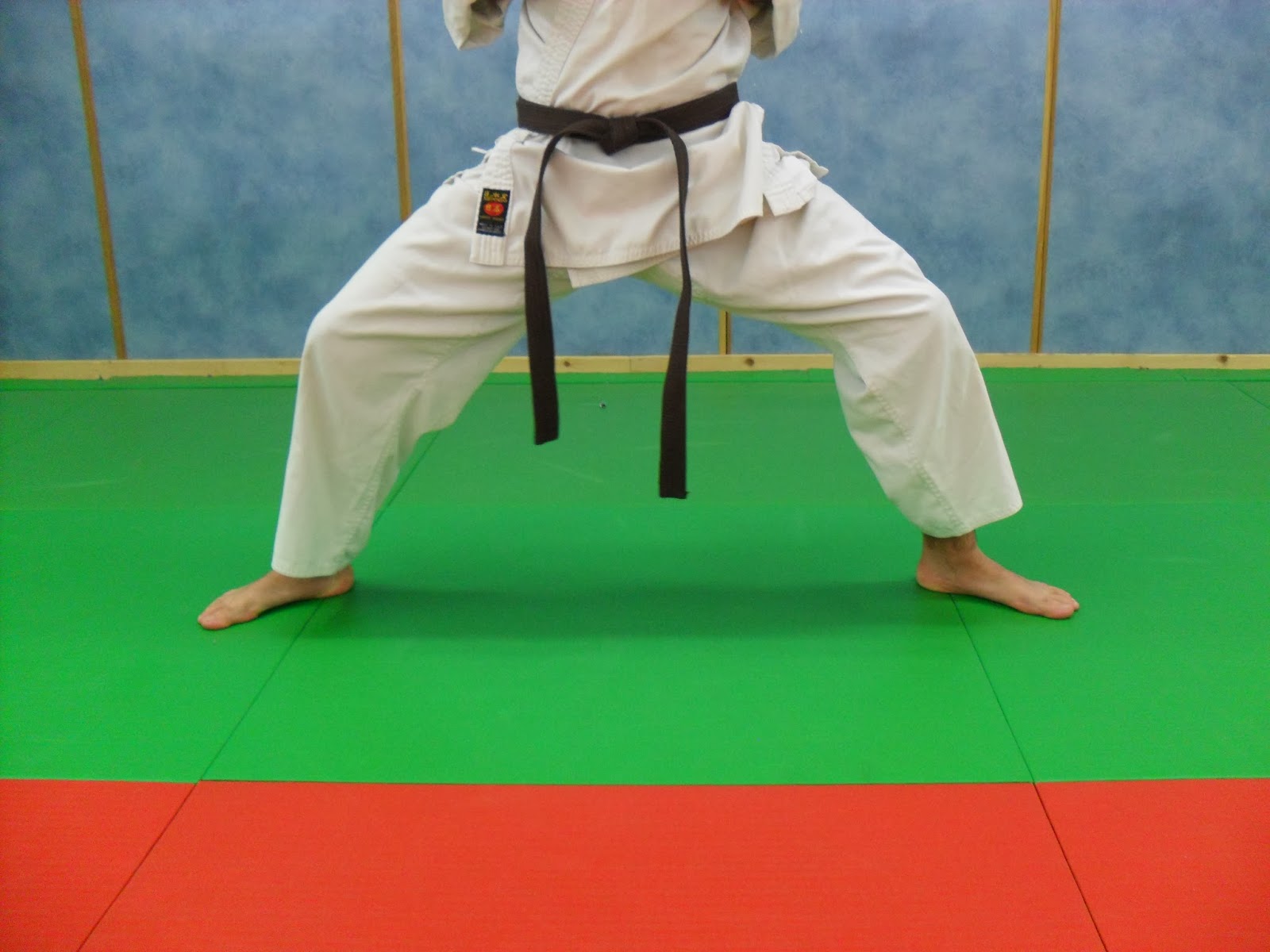
Before moving to kicks in “kihon”, I will explain about some stances. ‘Stance’ is “tachi” in Japanese but when you say the name of a certain stance, ‘tachi’ changes to ‘… dachi’ just for the convenience of pronunciation.
★   Heisoku dachi
“Hei” means ‘to close’ and “soku” means ‘feet’. “Heisoku dachi” is the stance that you place both feet together, no opening between both feet from toes to heels.

★   Musubi dachi
“Musubi” means ‘to tie/connect’. “Musubi dachi” is the stance that you open the both toes to 60 degrees from “heisoku dachi”. The heels are connected.

★   Heikou dachi
“Heikou” means ‘parallel’. You open the feet to your shoulder-width and the toes are facing to the front. Both feet should be parallel.

★   Fudou dachi or Soto hachiji dachi/Soto hachinoji dachi
“Fudou” means ‘not move/immobile’. From the position of “heikou dachi”, you move the toes outsides (60 degrees) then you are in the stance which you can stand immobile. 
“Hachi-ji or hachi no ji” means ‘a letter 8’. In Japanese letter(kanji), 8 is written 八. It’s like the shape of “sanchin dachi” and sometimes we call sanchin dachi “hachiji dachi”. But here it has “soto” which means ‘outside’ before “hachiji” because the opening of the toes are toward outside. The stance looks like the reverse of the letter 八 (the heels are on the same line)

★   Shiko dachi
 “Shiko” is from the movement that sumo wrestlers do to strengthen their legs. Please see the video to understand it. Note that the toes are pointed out.
      How to do "shiko" in sumo
So it is actually the same stance as this but you don’t lift up the legs in karate training. Practicing this stance will help improve your flexibility like all the sumo wrestlers who can open the legs 180 degrees!


★   Kiba dachi
“Kiba” means a trooper/soldier on a horse. It is almost like “shiko dachi” but you place the toes to the front and knees remain outwards. “Kiba-dachi’ is the stance that you imagine like riding a horse and you have to fight, so your bottom is down(sitting pose) but you need to put the power into both legs (not to fall from the horse) 


I explained about “fudou dachi” and “sanchin dachi” also in No. 11 and “kiba dachi” in No. 15


Tuesday, 21 January 2014

Japanese in Karate 18 "Uke"

“Uke” means ‘receiving’ in Japanese. In karate “uke” is to block the attack. I suppose it’s called “uke” in karate because by receiving the opponent’s attack rather than just blocking it, you can take the advantage of the opponent’s power and connect immediately to the counter attack.

★ Joudan uke  / age uke
“Jodan” means ‘upper level’. “Jodan uke” is the block against the high punch or kick from above.
It’s also called “age uke” in some styles. “Age” means ‘to lift up’.

★ Chuudan soto uke
“Chudan” means ‘middle level’ and “soto” means ‘outside’. “Soto uke” is the block which the arm and hand move from outside to inside.

★ Chuudan uchi uke
“Uchi” means ‘inside’ and “uchi uke” is the block which the arm and hand move from inside to outside.

★ Gedan barai
“Gedan” means ‘lower level’ and “barai” means ‘sweeping’. Japanese word for ‘sweeping’ is “harai” but because the word is combined with “gedan”, the sound of “harai” changes to “barai”. “Gedan barai” is the block against the opponent’s lower punch or lower leg attack by sweeping the arm.

★ Shutou mawashi uke
 “Shutou” is 'hand sword' (please refer to  blog No.16 ), “mawashi” means ‘making a circle’ or ‘turn something around’. In "shutou mawashi uke", you make shutou with both hands and block by moving the both hands in a circular motion.

★ Haitou uke
“Haitou” means ‘back of the sword”. It is the hand technique using the thumb side of the hand as opposed to the little finger side used in "shutou".


Saturday, 21 December 2013

Japanese in Karate 17 “Other hand attack techniques”

★Tettsui
“Tettsui” means ‘a hammer’. In karate technique, “tettsui” is the same handgrip as “seiken” but hit with the side of the little finger.
 

★Nukite
“Nuki” means to pierce and “te” is a hand. “Nukite” is the hand attack thrusting the fingertips towards opponent’s eyes, throat and a pit of the stomach or other vital spots.
You need the strength in your fingertips for this technique. The exercise called “nukite” after “gassho” exercise (to strengthen the wrists by pushing palms) in the warming up is to strengthen the fingertips for “nukite” technique.
 

★Shoutei / Shoutei-uchi
“Shou” means a palm as in “gasshou”. “Tei” means a bottom. “Shoutei” is a strike using the bottom of the palm.

★Kagi-zuki / Furi-uchi / Hook
‘Hook punch’ is called “hook” also in Japanese. Original Japanese word for ‘hook punch’ is “kagi-zuki” or “furi-uchi”. “Kagi” means a hook and “zuki” is “tsuki” which means punch/strike.
“Furi” means to swing. You make a fist and bend your arm like a hook then swing it toward the opponent from the side.


Wednesday, 27 November 2013

Japanese in Karate 16 "Shutou"


手 te          刀 katana


手刀shutou             


Shutou in kanji is 手刀. The first kanji 手 is “te” (= a hand/hands) and the second kanji 刀 is “katana” (= a sword) in Japanese. But when they are together, it's called "shutou". “Shu” and “tou” are the second reading of those kanji.
So “shutou” means ‘a hand sword’.
★Shutou ganmen uchi
“Ganmen” is ‘facial surface’ and “uchi” is ‘strike’. This is a hand sword strike to the face.
★Shutou sakotsu uchi
“Sakotsu” is ‘a collar bone’. This is a hand sword strike to the collarbone from above.
sakotsu (image by estar.jp)


★ Shutou sakotsu uchikomi
“Uchikomi” means to strike and push. We usually use this expression when we hammer the nail in. This is the hand sword strike, which you push it into the collarbone.
★Shutou uchi uchi
There are two “uchi” in this technique. But they are different words. The first “uchi” means ‘inside’ and the second “uchi” means ‘strike’. This is a hand sword strike, which you strike from inside.
★Shutou hizou uchi
 “Hizou” is the name of the organ (spleen) as shown in the picture. This is a hand sword strike towards this part of the body.
hizou(spleen)

Wednesday, 13 November 2013

Japanese in Karate 15 "Kiba-dachi" "Shita-zuki" and "Hiji-uchi"

Next “tachi” (stance) is “Kiba-dachi”. “Kiba” means a trooper/soldier on a horse. And “dachi” is “tachi” = stance.   “Kiba-dachi’ is the stance that you imagine like riding a horse and you have to fight, so your bottom is down(sitting pose) but you need to put the power into both legs (not to fall from the horse!)  In Japan, I always did the following basic movements with “kiba-dachi” in the training.
★Seiken shita-zuki
“Shita” means ‘under/below’ and “zuki” is “tsuki” = punch. “Gedan”下段 and “shita”下 are almost the same meaning. “Gedan-zuki” is the punch toward the lower level and “shita-zuki” is the punch from the lower level with the knuckle palm side up.

★Hiji uchi
“Hiji” means ‘elbows’ and “uchi” is ‘strike’ so “hiji uchi” is ‘elbow strike’. It is also called “enpi” in karate.
★ Hiji jodan uchi  / Hiji mawashi uchi
“Jodan” is ‘upper level’. “Mawashi” is ‘turn something around’. This is the elbow strike when you move the elbow around from the side to hit (the upper part of) the opponent.
★Hiji age uchi
“Age” means ‘to lift up’. This is the elbow strike when you lift up the elbow to hit the opponent.
★Hiji oroshi uchi
“Oroshi” means ‘to pull down’. This is the elbow strike when you first lift up the elbow and pull it down to hit the opponent.
<Extra Japanese knowledge>
下  this kanji means ‘under/below/lower’ and the Japanese word is “shita”. This kanji has the second reading, which is “ge”. When the word is combined with another word and makes a new combined word, the reading is usually the second one.  Therefore, for the word ‘lower level’, it’s actually “shita”下 + “dan”段 but the reading changes to “ge dan”         下段


hiji jodan uchi                                    hiji age uchi                                        hiji oroshi uchi

Saturday, 26 October 2013

Japanese in Karate 14 "hikite" and "uraken"

When you do “seiken zuki”, the other hand that pulls back to the side of the chest is called “hikite”. “Hiki” means to pull back and “te” is a hand.
“Uraken”
“Ura” means ‘back side’ and “ken” means ‘fist’. Therefore, “uraken” is a ‘back fist’.
When you attack with “uraken”, the punches are called “uchi” and not “tsuki”. What’s the difference between them?
The word tsuki” originally means ‘to stab or push” while “uchi” means to hit, strike and flap.
So you can imagine that “tsuki” is the punch that you push the fist into the opponent’s body and “uchi” is the punch that you hit/flap the opponent.
It’s easier to see the difference in the eyes so here is the demonstration.

☆“Uraken ganmen uchi” = back fist punch to the face
 “Ganmen” is ‘facial surface’. “Gan” means ‘face’ and “men” is ‘surface’ as in “shoumen”(front side). When you see the word in kanji(Chinese character) : 顔面  the first kanji 顔 means ‘face’ and this kanji has 2 readings, “gan” and “kao”. When you want to say the word just ‘face’ in Japanese, you must use the other reading “kao” not “gan” (just for extra knowledge)
☆“Uraken sayu uchi” = back fist punch to right and left
“Sayu” means ‘right and left’
☆“Uraken hizou uchi” or “Uraken furi uchi”
“Hizou” is the name of the organ (a body part) as shown in the picture. So this punch is aimed towards this part of the body.
(hizou)
“Furi” means ‘to swing’. If you swing the uraken to your right or left side, the fist will hit the same part (I suppose)
☆“Uraken mawashi uchi” = back fist round punch
“Mawashi” means ‘to turn something around’. In this technique, you swing the uraken around to the opponent.
☆“Seiken ago uchi”  
“Ago” means ‘a chin’. This attack is with “seiken” but the punch is “uchi” so your punch should just hit the opponent’s chin and pull it back. 

Wednesday, 2 October 2013

Japanese in Karate 13 "Seiken chudan zuki"

With “sanchin dachi” and “kiai”, we come to the punches.
Punching techniques = “tsuki” (it means ‘jab/thrust’)      as in “Tsuki no kata”
Seiken 正拳
"sei” of “seiken” is the same “sei” of “seiza” and it means ‘correct/proper’ and “ken” is “kobushi” which means ‘a fist/fists’. Therefore, “seiken” literally means ‘proper fists’.
Now when you say ‘punch with seiken’, it becomes “Seiken-zuki”.  “Zuki” is originally “tsuki” and when it comes after another word (in this case “seiken”), “tsu” changes to “zu” for the convenience of pronunciation.
“Seiken zuki” is to punch with the fist in a way that the joints of the forefinger and the middle finger (2 knuckles) will hit the opponent.
In “seiken zuki” there are;
Seiken chudan zuki :      Chudan 中段  “chu” means ‘middle’ and “dan” means                                                           ‘stage/level’ as in the levels of black belts
Seiken jodan zuki :          Jodan  上段  “jou/jo” means ‘up’ so “jodan” is ‘upper’
Seiken gedan zuki :         Gedan  下段  “ge” means ‘below’ so “gedan” is ‘lower’
There is also “seiken ago uchi” but I will explain this word in the next blog.
                           Seiken jodan zuki                                                 Seiken

image from : http://biyoubariyamamoto.web.fc2.com          jp.wikipedia.org/wiki/正拳突き
Osu

Thursday, 19 September 2013

Japanese in Karate 12 "Yooi" "Kamaete" "Kiai"

(12)ללמוד מילים ביפנית שמשתמשים באימון קראטה

"Youi" or "Yooi" means 'Get set!' 'Get ready'

When Sensei says "yooi", he is telling the students to get ready for the certain stance.
For example, "migi sanchin-dachi yooi"  is 'Get set for right leg front sanchin-dachi'

"Kamaete" means 'Do the stance!'  So when sensei says "Kamaete!", you are supposed to do the stance which he told you to get ready for.

"Kamae" without "te" is the noun 'stance'
"Kamaete" also means 'to get ready for a fight' when it is used in "kumite" (sparring)

When you do the stance, you also do "kiai".  What does "kiai" mean?

"kiai" in kanji is  気合.  気ki means 'spirit or air' and 合ai means 'to unite/ to merge'. So "kiai" literally means 'to unite the spirit'

In karate, "kiai" is the yelling/shouting to show your fighting spirit.
You have to shout from your belly(the center of the body) to summon up your spirit and to push yourself forward.

When you do "kiai", you breathe out and at the same time you need to put the power into the stomach muscle. That's the basic breathing technique in karate.
So whenever you do "kiai" in the training, you actually practice that technique too.

"Kiai irete"  : "irete" means 'to insert' in Japanese and we use this word also when we put the power into something. "Kiai irete!" in the training means 'with yelling' and 'with the fighting spirit' !

sanchin dachi
                                                                                      "Kamaete!"
Osu

Friday, 30 August 2013

Japanese in Karate 11 "Fudou-dachi" "Sanchin-dachi"

(11)ללמוד מילים ביפנית שמשתמשים באימון קראטה

I’ll try to explain all the Japanese words being used in Kihon (basic training) but there are so many words and I wonder how to start...  I’ll pick up the words according to the training I was used to in Japan and at the end of the series, I will list all the words by techniques.

I guess it ’s not the same order as your training (in Japan it’s the same almost everywhere though) and there might be some words which have different meanings in different style karate.

Please remember that I am going to explain about the Japanese words and not about the techniques or the training itself.

First of all, please remember these words. (in Japanese, single and plural words are the same)
hand/hands = TE  טה    手             leg/legs/foot/feet = ASHI  אשי    足
front, forward = MAE   מאה    前          back  (אחורה)= USHIRO אושילו  後
right (ימין) = MIGI  מיגי   右                   left (שמאל) = HIDARI הידאלי  左

(extra Japanese knowledge)
right hand = Migite, left hand = Hidarite, right leg = Migiashi, left leg = Hidariashi
front leg = Maeashi, back leg = Ushiroashi

Now, “kihon” starts from “Fudou-dachi” stance.

‘Stance’ (עמידה) is called “tachi” (“tachi” and “dachi” are the same word. When “tachi” comes after another noun, it changes to “dachi”)

“Fudou” means ‘not move/immobile’. So “fudou-dachi” is the firm stand and you shouldn't move. Sensei says “Fudou-dachi!” when he wants to start something and he doesn't want the students to move around or move the body at all.

Fudou-dachi

Then the first stance for practicing ‘tsuki’ (punches) is “sanchin-dachi”.

“Sanchin” in kanji (Chinese characters) means ‘three fights’. Someone explains on the internet (actually I also didn't know the real meaning)  that it’s because you prepare to fight in 3 directions - front(Mae), right(Migi), and left(Hidari). And the point of the stance is that you keep stability when you attack or block to the front and to the sides. For that you have to concentrate the power to both legs and feet. I remember Sensei always said "grab the floor with your feet" 

Sanchin-dachi

“Migi-sanchin-dachi”      the right foot forward
“Hidari-sanchin-dachi”   the left foot forward

Osu