Saturday, 15 February 2014

Japanese in Karate 19 "Tachi"

Before moving to kicks in “kihon”, I will explain about some stances. ‘Stance’ is “tachi” in Japanese but when you say the name of a certain stance, ‘tachi’ changes to ‘… dachi’ just for the convenience of pronunciation.
★   Heisoku dachi
“Hei” means ‘to close’ and “soku” means ‘feet’. “Heisoku dachi” is the stance that you place both feet together, no opening between both feet from toes to heels.

★   Musubi dachi
“Musubi” means ‘to tie/connect’. “Musubi dachi” is the stance that you open the both toes to 60 degrees from “heisoku dachi”. The heels are connected.

★   Heikou dachi
“Heikou” means ‘parallel’. You open the feet to your shoulder-width and the toes are facing to the front. Both feet should be parallel.

★   Fudou dachi or Soto hachiji dachi/Soto hachinoji dachi
“Fudou” means ‘not move/immobile’. From the position of “heikou dachi”, you move the toes outsides (60 degrees) then you are in the stance which you can stand immobile. 
“Hachi-ji or hachi no ji” means ‘a letter 8’. In Japanese letter(kanji), 8 is written 八. It’s like the shape of “sanchin dachi” and sometimes we call sanchin dachi “hachiji dachi”. But here it has “soto” which means ‘outside’ before “hachiji” because the opening of the toes are toward outside. The stance looks like the reverse of the letter 八 (the heels are on the same line)

★   Shiko dachi
 “Shiko” is from the movement that sumo wrestlers do to strengthen their legs. Please see the video to understand it. Note that the toes are pointed out.
      How to do "shiko" in sumo
So it is actually the same stance as this but you don’t lift up the legs in karate training. Practicing this stance will help improve your flexibility like all the sumo wrestlers who can open the legs 180 degrees!
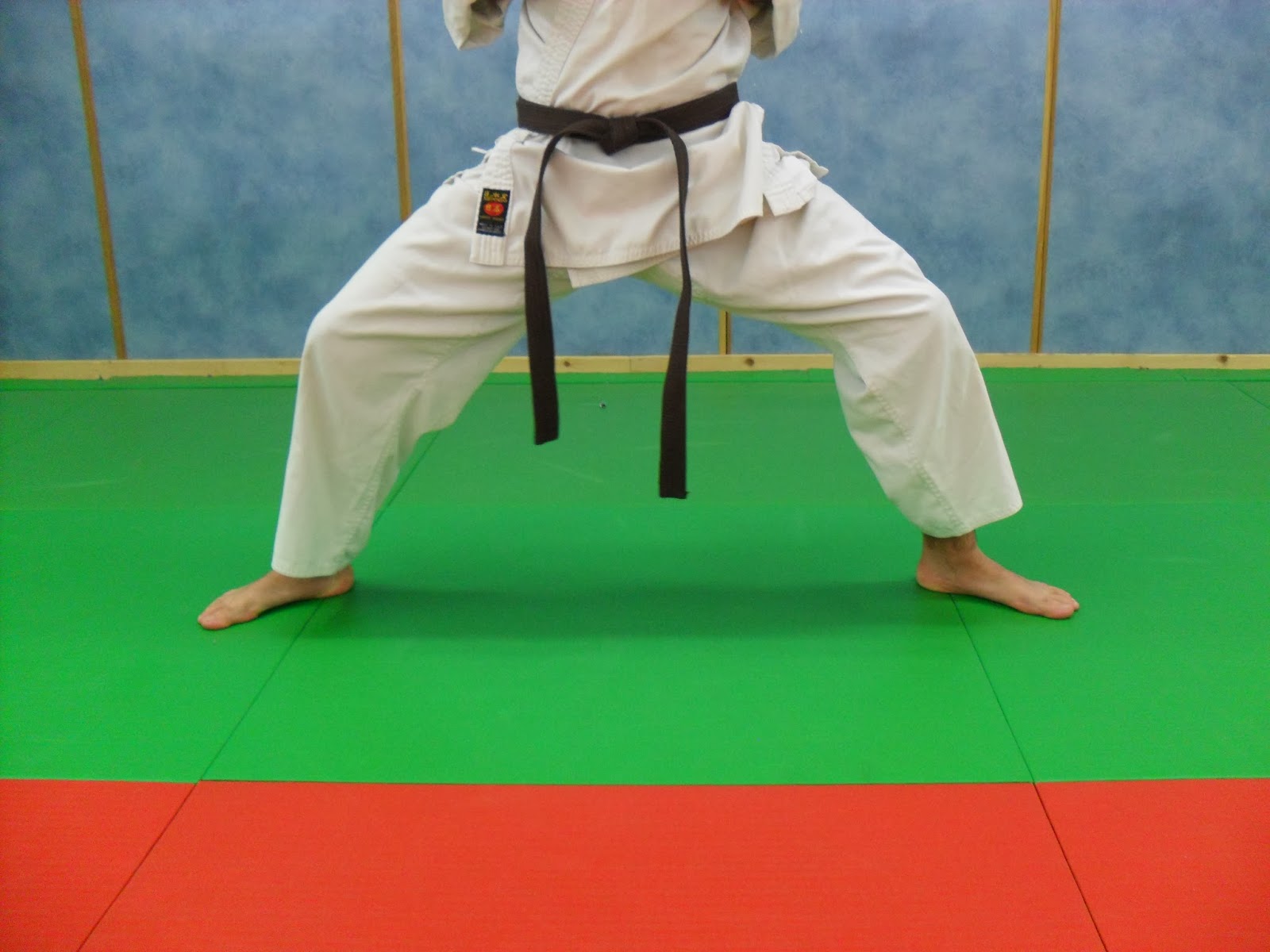

★   Kiba dachi
“Kiba” means a trooper/soldier on a horse. It is almost like “shiko dachi” but you place the toes to the front and knees remain outwards. “Kiba-dachi’ is the stance that you imagine like riding a horse and you have to fight, so your bottom is down(sitting pose) but you need to put the power into both legs (not to fall from the horse) 


I explained about “fudou dachi” and “sanchin dachi” also in No. 11 and “kiba dachi” in No. 15


Tuesday, 21 January 2014

Japanese in Karate 18 "Uke"

“Uke” means ‘receiving’ in Japanese. In karate “uke” is to block the attack. I suppose it’s called “uke” in karate because by receiving the opponent’s attack rather than just blocking it, you can take the advantage of the opponent’s power and connect immediately to the counter attack.

★ Joudan uke  / age uke
“Jodan” means ‘upper level’. “Jodan uke” is the block against the high punch or kick from above.
It’s also called “age uke” in some styles. “Age” means ‘to lift up’.

★ Chuudan soto uke
“Chudan” means ‘middle level’ and “soto” means ‘outside’. “Soto uke” is the block which the arm and hand move from outside to inside.

★ Chuudan uchi uke
“Uchi” means ‘inside’ and “uchi uke” is the block which the arm and hand move from inside to outside.

★ Gedan barai
“Gedan” means ‘lower level’ and “barai” means ‘sweeping’. Japanese word for ‘sweeping’ is “harai” but because the word is combined with “gedan”, the sound of “harai” changes to “barai”. “Gedan barai” is the block against the opponent’s lower punch or lower leg attack by sweeping the arm.

★ Shutou mawashi uke
 “Shutou” is 'hand sword' (please refer to  blog No.16 ), “mawashi” means ‘making a circle’ or ‘turn something around’. In "shutou mawashi uke", you make shutou with both hands and block by moving the both hands in a circular motion.

★ Haitou uke
“Haitou” means ‘back of the sword”. It is the hand technique using the thumb side of the hand as opposed to the little finger side used in "shutou".


Saturday, 21 December 2013

Japanese in Karate 17 “Other hand attack techniques”

★Tettsui
“Tettsui” means ‘a hammer’. In karate technique, “tettsui” is the same handgrip as “seiken” but hit with the side of the little finger.
 

★Nukite
“Nuki” means to pierce and “te” is a hand. “Nukite” is the hand attack thrusting the fingertips towards opponent’s eyes, throat and a pit of the stomach or other vital spots.
You need the strength in your fingertips for this technique. The exercise called “nukite” after “gassho” exercise (to strengthen the wrists by pushing palms) in the warming up is to strengthen the fingertips for “nukite” technique.
 

★Shoutei / Shoutei-uchi
“Shou” means a palm as in “gasshou”. “Tei” means a bottom. “Shoutei” is a strike using the bottom of the palm.

★Kagi-zuki / Furi-uchi / Hook
‘Hook punch’ is called “hook” also in Japanese. Original Japanese word for ‘hook punch’ is “kagi-zuki” or “furi-uchi”. “Kagi” means a hook and “zuki” is “tsuki” which means punch/strike.
“Furi” means to swing. You make a fist and bend your arm like a hook then swing it toward the opponent from the side.


Wednesday, 27 November 2013

Japanese in Karate 16 "Shutou"


手 te          刀 katana


手刀shutou             


Shutou in kanji is 手刀. The first kanji 手 is “te” (= a hand/hands) and the second kanji 刀 is “katana” (= a sword) in Japanese. But when they are together, it's called "shutou". “Shu” and “tou” are the second reading of those kanji.
So “shutou” means ‘a hand sword’.
★Shutou ganmen uchi
“Ganmen” is ‘facial surface’ and “uchi” is ‘strike’. This is a hand sword strike to the face.
★Shutou sakotsu uchi
“Sakotsu” is ‘a collar bone’. This is a hand sword strike to the collarbone from above.
sakotsu (image by estar.jp)


★ Shutou sakotsu uchikomi
“Uchikomi” means to strike and push. We usually use this expression when we hammer the nail in. This is the hand sword strike, which you push it into the collarbone.
★Shutou uchi uchi
There are two “uchi” in this technique. But they are different words. The first “uchi” means ‘inside’ and the second “uchi” means ‘strike’. This is a hand sword strike, which you strike from inside.
★Shutou hizou uchi
 “Hizou” is the name of the organ (spleen) as shown in the picture. This is a hand sword strike towards this part of the body.
hizou(spleen)

Wednesday, 13 November 2013

Japanese in Karate 15 "Kiba-dachi" "Shita-zuki" and "Hiji-uchi"

Next “tachi” (stance) is “Kiba-dachi”. “Kiba” means a trooper/soldier on a horse. And “dachi” is “tachi” = stance.   “Kiba-dachi’ is the stance that you imagine like riding a horse and you have to fight, so your bottom is down(sitting pose) but you need to put the power into both legs (not to fall from the horse!)  In Japan, I always did the following basic movements with “kiba-dachi” in the training.
★Seiken shita-zuki
“Shita” means ‘under/below’ and “zuki” is “tsuki” = punch. “Gedan”下段 and “shita”下 are almost the same meaning. “Gedan-zuki” is the punch toward the lower level and “shita-zuki” is the punch from the lower level with the knuckle palm side up.

★Hiji uchi
“Hiji” means ‘elbows’ and “uchi” is ‘strike’ so “hiji uchi” is ‘elbow strike’. It is also called “enpi” in karate.
★ Hiji jodan uchi  / Hiji mawashi uchi
“Jodan” is ‘upper level’. “Mawashi” is ‘turn something around’. This is the elbow strike when you move the elbow around from the side to hit (the upper part of) the opponent.
★Hiji age uchi
“Age” means ‘to lift up’. This is the elbow strike when you lift up the elbow to hit the opponent.
★Hiji oroshi uchi
“Oroshi” means ‘to pull down’. This is the elbow strike when you first lift up the elbow and pull it down to hit the opponent.
<Extra Japanese knowledge>
下  this kanji means ‘under/below/lower’ and the Japanese word is “shita”. This kanji has the second reading, which is “ge”. When the word is combined with another word and makes a new combined word, the reading is usually the second one.  Therefore, for the word ‘lower level’, it’s actually “shita”下 + “dan”段 but the reading changes to “ge dan”         下段


hiji jodan uchi                                    hiji age uchi                                        hiji oroshi uchi

Saturday, 26 October 2013

Japanese in Karate 14 "hikite" and "uraken"

When you do “seiken zuki”, the other hand that pulls back to the side of the chest is called “hikite”. “Hiki” means to pull back and “te” is a hand.
“Uraken”
“Ura” means ‘back side’ and “ken” means ‘fist’. Therefore, “uraken” is a ‘back fist’.
When you attack with “uraken”, the punches are called “uchi” and not “tsuki”. What’s the difference between them?
The word tsuki” originally means ‘to stab or push” while “uchi” means to hit, strike and flap.
So you can imagine that “tsuki” is the punch that you push the fist into the opponent’s body and “uchi” is the punch that you hit/flap the opponent.
It’s easier to see the difference in the eyes so here is the demonstration.

☆“Uraken ganmen uchi” = back fist punch to the face
 “Ganmen” is ‘facial surface’. “Gan” means ‘face’ and “men” is ‘surface’ as in “shoumen”(front side). When you see the word in kanji(Chinese character) : 顔面  the first kanji 顔 means ‘face’ and this kanji has 2 readings, “gan” and “kao”. When you want to say the word just ‘face’ in Japanese, you must use the other reading “kao” not “gan” (just for extra knowledge)
☆“Uraken sayu uchi” = back fist punch to right and left
“Sayu” means ‘right and left’
☆“Uraken hizou uchi” or “Uraken furi uchi”
“Hizou” is the name of the organ (a body part) as shown in the picture. So this punch is aimed towards this part of the body.
(hizou)
“Furi” means ‘to swing’. If you swing the uraken to your right or left side, the fist will hit the same part (I suppose)
☆“Uraken mawashi uchi” = back fist round punch
“Mawashi” means ‘to turn something around’. In this technique, you swing the uraken around to the opponent.
☆“Seiken ago uchi”  
“Ago” means ‘a chin’. This attack is with “seiken” but the punch is “uchi” so your punch should just hit the opponent’s chin and pull it back. 

Wednesday, 2 October 2013

Japanese in Karate 13 "Seiken chudan zuki"

With “sanchin dachi” and “kiai”, we come to the punches.
Punching techniques = “tsuki” (it means ‘jab/thrust’)      as in “Tsuki no kata”
Seiken 正拳
"sei” of “seiken” is the same “sei” of “seiza” and it means ‘correct/proper’ and “ken” is “kobushi” which means ‘a fist/fists’. Therefore, “seiken” literally means ‘proper fists’.
Now when you say ‘punch with seiken’, it becomes “Seiken-zuki”.  “Zuki” is originally “tsuki” and when it comes after another word (in this case “seiken”), “tsu” changes to “zu” for the convenience of pronunciation.
“Seiken zuki” is to punch with the fist in a way that the joints of the forefinger and the middle finger (2 knuckles) will hit the opponent.
In “seiken zuki” there are;
Seiken chudan zuki :      Chudan 中段  “chu” means ‘middle’ and “dan” means                                                           ‘stage/level’ as in the levels of black belts
Seiken jodan zuki :          Jodan  上段  “jou/jo” means ‘up’ so “jodan” is ‘upper’
Seiken gedan zuki :         Gedan  下段  “ge” means ‘below’ so “gedan” is ‘lower’
There is also “seiken ago uchi” but I will explain this word in the next blog.
                           Seiken jodan zuki                                                 Seiken

image from : http://biyoubariyamamoto.web.fc2.com          jp.wikipedia.org/wiki/正拳突き
Osu